


By Ifésinàchi Nwàdiké
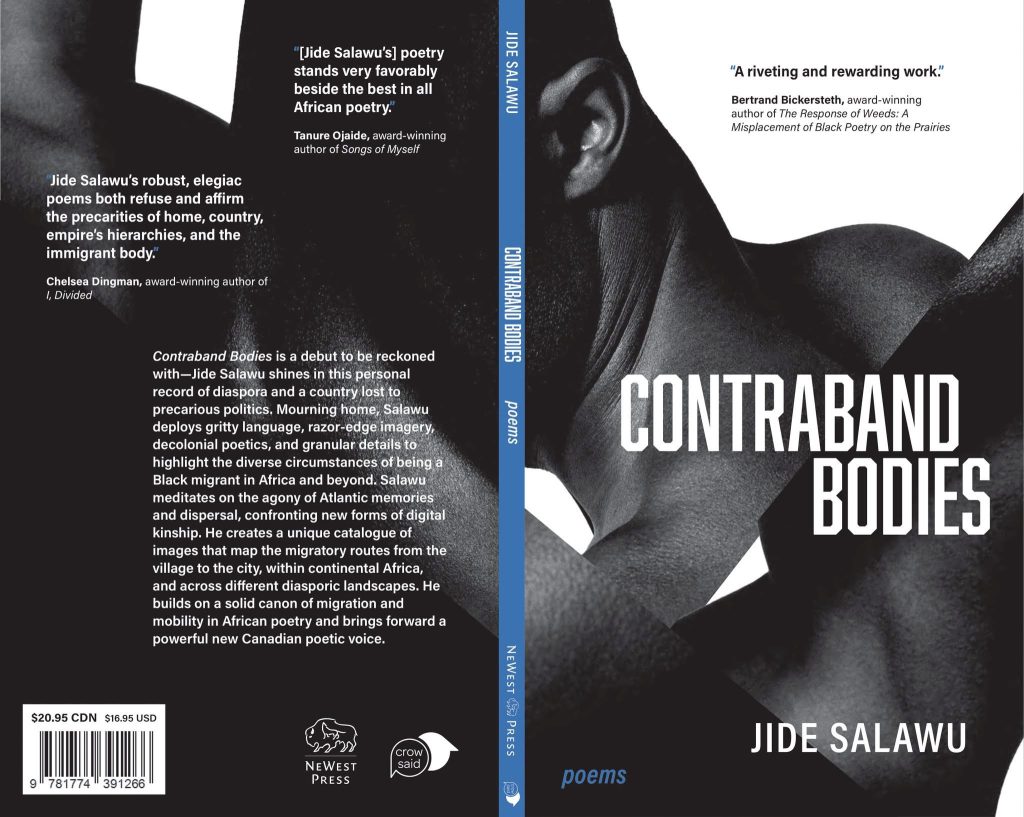
In Jide Salawu’s Contraband Bodies (NeWest Press, 2025), the image of black bodies travelling assumes palpable materiality. The exilic undertones in the collection are depicted as voluntary exercise. Voluntary in the sense that these black bodies are embarking on exile out of their own will. But there is an implied involuntariness in the sense of the fact that “nobody leaves home unless home is the mouth of a shark” (Warsan Shire, 2023). Years of arbitrary misgovernance, insecurity, constantly decreasing life expectancy rate as a result of the nation’s inordinate desire to remain stagnant, and a fantastic misuse of the gains of independence, all coalesce to drive the young African body into a constant negotiation with his or her feet. Japa–as the new, unbridled, massive wave of exodus from Africa, is now fondly called–becomes the incentive for a hopeful life. This is the backstory to the centrality of Salawu’s audacious narrativization of the migrant body, the black body in flight.
Jide Salawu is a Nigerian Canadian poet whose latest collection captures what it means to migrate as a black skin in the 21st century. From America to Canada; the UK and all other parts of Europe, Asia and the rising Arab economy, the black body is a contraband body, a regional baggage that requires a little more frisking, a little more questioning, a little more airport delays, segregation and harassments that are intended to hurt and demean the pride and dignity of the black person. Aside the mean-faced immigration officers at international airports, the Mediterranean Sea via the Agadez-Tripoli route has menaced the bodies of African exiles – a toll that is nearly quantifiable with that of the slave trade era.
Salawu’s enthralling collection populates the evolving canon of migration and diasporic thematizations in African poetry. It offers an enduring insight into the many facets of migrants’ experiences. It is an open invitation to see how migration, for the African traveler, is no longer a temporary movement for education or business, but a total escape–a means to a new beginning in another presumably better space. Young and upward Africans are renegotiating their futures by heavily investing in the dislocation and relocation of their bodies away from postcolonial sites of the undesirable life. Salawu’s major achievement in Contraband Bodies is in the way he not just delineates the pains and psychological traumas experienced by both legal and illegal migrants, he provides a rich context as to why this is happening, thereby framing the black body as a victim: “I have no stomach to keep sea stories,” he writes, “Ten thousand boys are crossing / the black Atlantic without life jackets” (7). Why take such risks, one may ask? Well, according to the poet, “there is no hierarchy of those rushing out of a country’s flame” (7). Nigeria is a beautiful country, sadly marred by the postcolonial inefficiencies. Salawu classifies Nigeria as “a country with no honour to its name” (26), a country that stifles the ambitions and talents of its citizens. To be able to utilize their talents to their fullest potentials, the Nigerian youth have always looked elsewhere, hence they “pay the price for leaving by first dying” (32).
Dissatisfaction with one’s country and the eventual relocation of the self from that country, is, according to the world Salawu paints, a minute aspect of the processes of transition. The coldness, the loneliness, depression, racism and humiliation that awaits the contraband body, whether legally migrating for studies, job, or vacation, require the development of a tough skin to withstand the floodgate of overwhelming defeat and smallness there is to be felt. Same goes for the illegal migrants who survive the sea route. This is because “there are no pleasantries / for bodies in constant flight,” for they soon “learn about a different cold / when your land names you an unclean thing” (53).
It is hard to know where your body
belongs once you cross the sea.
It is hard to wash
yourself clean in a country
that calls you dirt (54).
To shed themselves of this “dirt,” a new struggle sets in–the struggle to belong in the new environment through, sometimes, funny imitations of the fashions and speaking mannerisms of the hosts. For these contraband bodies, there is always a voice that says: “Brotherman, I do not wish / to carry my old country / on my back, like an old fragile uncle” (30). Salawu speaks about the “razor-teeth winter” in Canada where, as “an African migrant, / there may be doors closing / at the first syllable of your country” (23), where some immigration officers at the airport enjoy the “fine art” of watching “the immigrants beg for mercy” (46). I think of this razor-teeth winter as the coldness of rejection of the black body, the undesirables. Salawu takes us from Canada to America, to Denmark, to the United Kingdom, Spain, Italy, but most ironically, to South Africa, where Black to Black racism is rife with attendant violence. In these spaces, Salawu’s persona shares his experiences with racism, cold, fire, electrocution, loneliness, hardship, food allergy, and the nonstop ritual of black tax. The persona, thus, speaks for every migrant, every contraband body who share in this communion of flight.
Contraband Bodies meditates also on a different kind of migration–death–through which the persona expresses the trauma of personal losses: a mother; an aunt; a grandmother; and all contraband bodies that took flight from the persona’s life. The poet persona, too, is a contraband body, migrating ever so often, in search of light and only remembering home in stories told by his grandfather and the memories he made of home as a child.
In a language that is lyrical, fierce, and sharp with lofty passion, Jide Salawu announces his appreciation of the postcolonial precarities of his continent and home country, and how these uncertainties and collective shame follow the citizens about irrespective of how far, how distant they run from home. The ugliness of the country is a code of shame emblazoned on the forehead of anyone who lays claim to it, such that even in faraway Canada, Salawu’s voice is sonorous with songs that detail the impossibility of delinking the migrant self from that ugliness, that shame.
Poet, Essayist, and Playwright, Ifésinàchi Nwàdiké is the author of the poetry collection, How Morning Remembers the Night (Winepress 2020), which won the First Runner-up to the Association of Nigerian Authors Poetry Prize, 2020, and was Longlisted for the inaugural Pan-African Writers Association Poetry Prize, 2022. Some of his poems, essays, and reviews have appeared in IHRAM Press, Maroko, Nokoko (Issues 8 & 10), Brittle Paper, Ake Literary Review, Kalahari Review, Olongo Africa, Lunaris Review, Ludd Gang, and elsewhere. An inaugural fellow of the Black Orpheus Exploration Residency, his sophomore collection of poems, How We Became Heroes, was published in 2025 by Noirledge Publishing.