


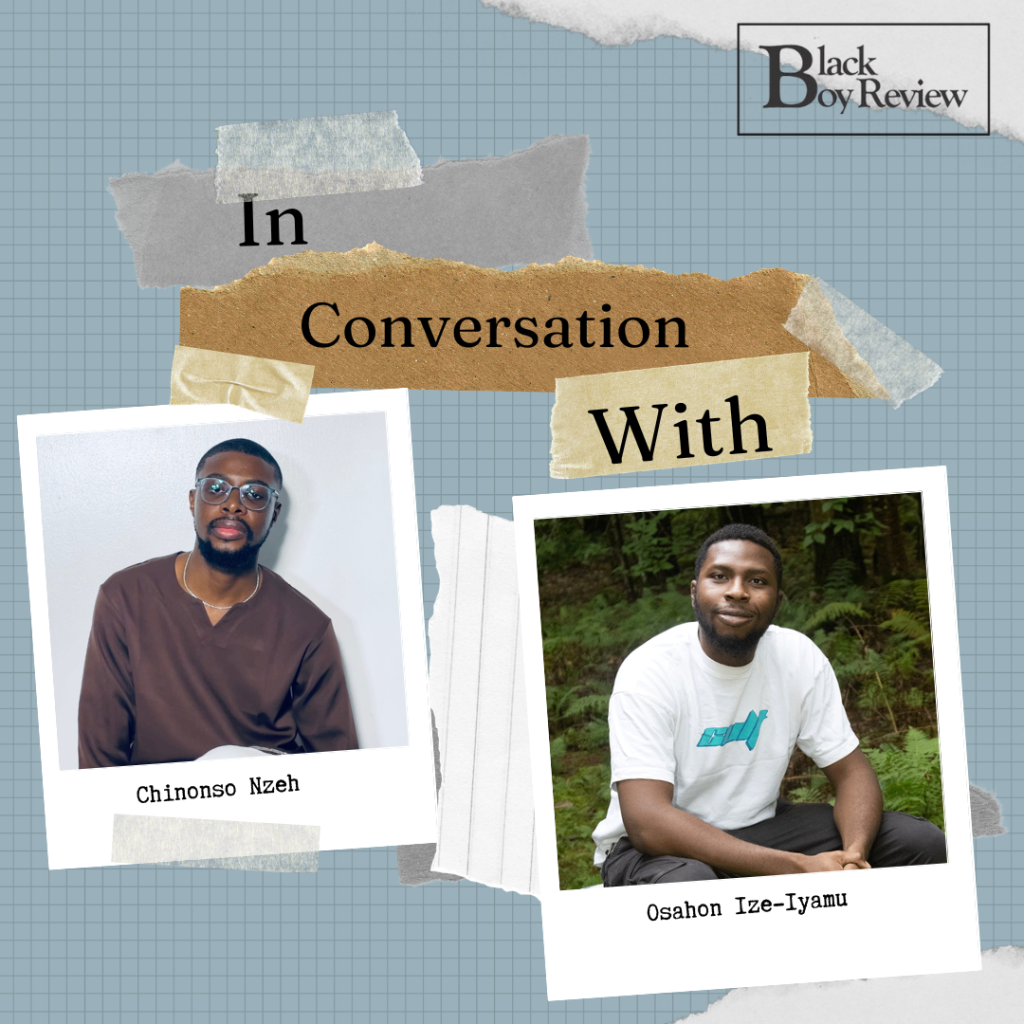
This conversation was over a call. For this talk, Black Boy Review’s Editor-in-Chief, Chinonso Nzeh engages Osahon Ize-Iyamu—the former in Lagos and the latter in Abuja. In this edition, they touch on craft, obligation, childhood, amongst other things.
Chinonso Nzeh:
Hello, Osahon. It is truly a pleasure to finally have this long conversation with you. I have known your work for five years now, and my admiration for it has not waned. I still remember the first piece of yours that I read, More Sea Than Tar, a remarkably beautiful narrative. I was struck by the way it brings the personal into conversation with the environment so seamlessly. In the years since, I’ve taught the piece in two workshops, and I’ve gone on to read almost everything you’ve written. It is such an honour to have you here.
Osahon Ize-Iyamu:
Hi Chinonso, it’s so wonderful doing this with you. And yes, I feel the same way about your work. Since I read The Slipping Away, I have been a fan of yours. I recommend it to everyone. You do this special thing with language. I appreciate people who can write emotions, people who are unafraid and vulnerable in their work. It is truly a pleasure doing this with you!
C.N:
I’ve been thinking a lot about childhood. You know, I think our childhood is such a formative facet of our lives as writers. In my years of craft, I’ve watched interviews of writers, and most of them had two things in common: an immense wonder of the world and books to read. Mine wasn’t any different. I grew up reading a lot of children’s books—shoutout, mostly, to Enid Blyton. My imagination was so active, and I remember my first ever work; I titled it “Fellow Jesus.” As a child, I was pretty self-absorbed—as most children were—and I remember thinking: I wanted to be taken so seriously, what if Judgment Day comes and I was Jesus Christ all along? I think of it now and laugh, even though a friend said a little more sharpening would make it a brilliant story.
O.I:
Haha! You should actually think of sharpening that story. It’s something I’d like to see. That’s such an interesting perspective.
It’s so interesting, indeed, how our childhoods are so similar. My childhood was, well, a whole lot of daydreaming, almost as you said. I was so curious and always in deep thought, imagining stories and scenes. I had a lot of toys and there were a lot of reimagining “scenes” with them. For me, that translated into love for writing. Especially with the books I read. You know, reading made me realize I could create stories with language, and it was something that pulled me, so I did it.
I liked comedy. I liked the whimsical. Even wrestling, you know. And it wasn’t merely for the fact that they were wrestling, but because of the theatrics. I was so drawn to the unconventional, dreaming about the world in a sense of possibility that stretched beyond the normal, and I had deep anxieties about the world, so this informed my writing. What about yours?
Also, in primary school, I remember my teacher storming into class one day, saying that we were not impressing him enough. Apparently, a student in the other class had created good art and won a competition, so that stirred something in me. That zeal to create something. My parents, too, were also really supportive of my writing: always asking about what I was writing, always reading my work. I discovered, too, that my dad wanted to write; that was a drive.
C.N:
Unlike you, I was drawn to melancholia as a child. I hate to say this, but I think this informed that constant sense of deep angst in my writing. I love(d) complex emotions: sadness, apprehension, gloom. And this is beyond writing to wreck nerves—I honestly couldn’t care less about that—and more about trying to understand these emotions. What informs sadness? Why do people worry? It became a way to understand why such things happened.
The parents’ part is so relatable, because my parents always supported my art, and I still think of it today: if these people weren’t my first cheerleaders, how would I have grown so confident in this art? Parental support—and any other pioneering support, really—is so pivotal in childhood.
Every so often, there’s a conversation on social media and even the global literary space that whirls in. A conversation about craft and global regions. For example, some writers argue that African writers (and writers in the global south) need to write less about their country’s politics and events; some argue they need to write more about it because the point of literature is to deeply inform and mirror society. So, now, I’m thinking: at what point does a writer have the luxury to write whatever?
O.I:
Thank you so much for that breakdown on writing emotions. It’s worth thinking deeply about.
For the conversation about the obligation to write these things, I genuinely do not know if I do. That may flatten the idea of what writing means to each writer. However, I understand it. I really do. Poverty, trauma, war; these are things that affect us, and definitely, we can write about them. But I don’t think every writer must explore this. There’s nuance. Beyond all of this, there are other things: our spirituality, our pleasures, the mundane. These things define us, too.
What matters, really, as a writer, at the end of the day, is how honest the work is; how sincere it reads. This can manifest itself in various forms.
C.N:
Full stop.
I really like this perspective. When we begin to decide what writers should or shouldn’t write, it obfuscates the whole point of writing. I say this as a writer drawn to these “conventional” things. We really should write what is true to us; what makes us satisfied. Someone will resonate with the work. Literature is supposed to be varied. It is supposed to have many branches and bear many fruits.
I think about faith a lot when it comes to writing. Some writers use faith as a vehicle for their work (think C.S Lewis), as a symbol (think Flannery O’Connor), or as a premise to which their art is done, but not necessarily the thing itself (think Toni Morrison), or even faith as absence (think Franz Kafka). Increasingly, these days, I’ve been thinking of how it informs the writer’s work, because as humans, we often stay in wonder, often try to unravel enigma, and faith is one of them. I’d like to hear your thoughts before I say mine.
O.I:
This is such a contemplative ask. I’m curious as to how you approach faith in your own work as well. I think of it in the faith, fear, and fantastical triangle. Surprisingly, one of my favourite books, Hell Is the Absence of God by Ted Chiang, explores the absence of faith, and I think it does that so strikingly.
Personally, I don’t know if faith is a vehicle for my work, but it certainly informs the decisions. It is inextricable especially when writing about modern-day Nigeria. This is how people approach the world; that’s what draws perspectives in how we think about faith. If I have to write stories in which the characters react to the sense of the world, then their faith—which informs their decisions—should be explored.
I’m also thinking of the fact that I rarely see that we explore the positives when it comes to faith; by this, I do not mean glamorizing, but in a way that does not suggest conceding or apologising for faith. I’m curious about more interesting ways: for example, inquiring into the hows and whys of a faith crisis rather than what I think is the tired exploration of the crisis itself. I’d really like to see that.
C.N:
I’ve been Catholic for nearly two years now. Before 2024, I was irreligious, and that perspective shaped my work. Even then, I was drawn to how deeply faith influences people’s lives, and I explored that from the outside.
Now, though, my approach feels broader and more expansive. Where I once leaned toward a binary—casting the morally upright as religious and the irreligious as lacking scruples—I’m more interested in the shades in between. I’m exploring the moral complexities that exist both within and outside of faith, paying attention to its presence as much as its absence. Before, my work focused largely on absence; now, it holds space for both.
And as you mentioned about interrogating the positives, I find myself trying to do that too: engaging faith not just critically, but curiously, examining what it offers as much as what it obscures.
Also, I’m still thinking of what we explore as writers. I think it is such an interesting topic. Can you circle more into what you’ve been writing?
O.I:
Thank you for that insight on faith.
I’m thinking of how musicians go off after an album. I’m done with the short story collection as you know, and now I’m working on a novel, and surely, there will always be another. It’s in phases. Not necessarily in the context of the crafting getting better—this can be a dimension of it—but in the context of exploring different things. And you know, a part of our sensibilities at the given time are put there, subconsciously or not. I know craft and reading is important, but experiences also birth ideas and phases. This way, we can tell stories that are not often told; we can tell stories with a textured premise. We can tell stories exploring things unsaid; a lot of the best writing leaves things unsaid. You can still feel the complexities without spelling it out. It is not easy to achieve this, except through experience, whether lived or indirectly
In sum, I think of our works in phases, all clumped into different times.
CN:
Ah, wow. I’ve never given the album thing much thought, but I find that it’s so true for me also. Thanks so much for that. Now that I think of it, I was having a conversation with a writer friend recently, and he said this but in a different way. It is honestly so beautiful that we almost live similar lives. Even with what you said about experience, I believe that much of everything good I have written was either born from experience or proximity to a person who has experienced the event. We can never know it all through books; we need to go out and touch grass sometimes. Haha!
Every writer is always in conversation with another writer. Which writers do you think speak to you? I was re-reading Arundhati Roy’s The God of Small Things recently, and in some way it speaks to my novel-in-progress: the characters and the language and the environment; it’s not even an overt parallel, but it’s there. Sometimes it’s simply the same spirit and nothing more. How about you? And who are you reading that you’re geeked about?
O.I:
This is a good question, and I’m thinking of Pemi Aguda. I like how she plays with the story, the humor, the experiment, the silly. And for the silly, I think there’s a level of commitment and seriousness to be silly and do it well in the work. I’m very very drawn to that.
For whom I’m reading and geeking about, there’s The Secret History by Donna Tartt; not many people like it, but I highly recommend it. There’s Terms and Condition, a short story by Daniel Lefferts in Yale Review. The Age of Calamities by Senaa Ahmad, a historical fiction that is so fresh. And of course, my two favorites from Pemi Aguda: Manifest and Caterer Caterer.
C.N:
These are all brilliant books and stories! Pemi Aguda is a writer I deeply admire, too, and I read her very often. It’s always so refreshing seeing what she does with prose. For Senaa Ahmad’s novel, I will check it out; never read it.
I’m currently re-reading Chimamanda Ngozi Adichie’s Dream Count; I’m drawn to Chia’s meditative prose. I like good language. I’m also reading The Crimson Petal and the White by Michel Faber; the prose is so good. It’s set in the Victorian Era, and the characters are morally complex.
O.I:
Ah, Dream Count. I liked it! It felt like four character studies in one. I think some parts work better than the other but overall it comes together really interestingly as a whole. As for Michel Faber’s novel, I’ll check it out. It seems like such an important read.
C.N:
Finally, I’m saying thank you, Osahon, for your time. This was wholesome, brief as it was. Let’s do this again in ten years. All things being equal, we would have grown so much by then. Deal?
O.I:
Deal!
Osahon Ize-Iyamu is a Nigerian writer whose work explores the intersection of fear, faith, and the fantastical. His work utilizes oral storytelling traditions, unconventional structures, gist, and superstition, to showcase the complexities of non-Western reality. He is an alumnus of the Alpha Young Writers workshop, and the Clarion Writer’s Workshop. His work has been published in magazines such as The Rumpus, Strange Horizons, Clarkesworld, Reckoning and Lightspeed Magazine. He is the recipient of a MacDowell fellowship and has spoken about his work at AWP, Story Hour, and Berlin’s Climate Culture Festival. You can find him online @osahon4545.
Chinonso Nzeh is an Igbo writer and photojournalist whose work explores nuances in the human condition. His writing appears in Evergreen Review, Isele Magazine, Agbowó, Zikoko Love Life Anthology, and elsewhere, and has been recognised in Afrocritik’s notable works lists for three consecutive years. He won the 2023 Isele Prize for Nonfiction and was runner-up for the 2024 Sevhage Prize. He edits for Black Boy Review and Lolwe, teaches writing, and is pursuing an LL.B at the University of Lagos, where he also serves as Editor-in-Chief of the Law Students’ Blog. He is working on his debut novel.