


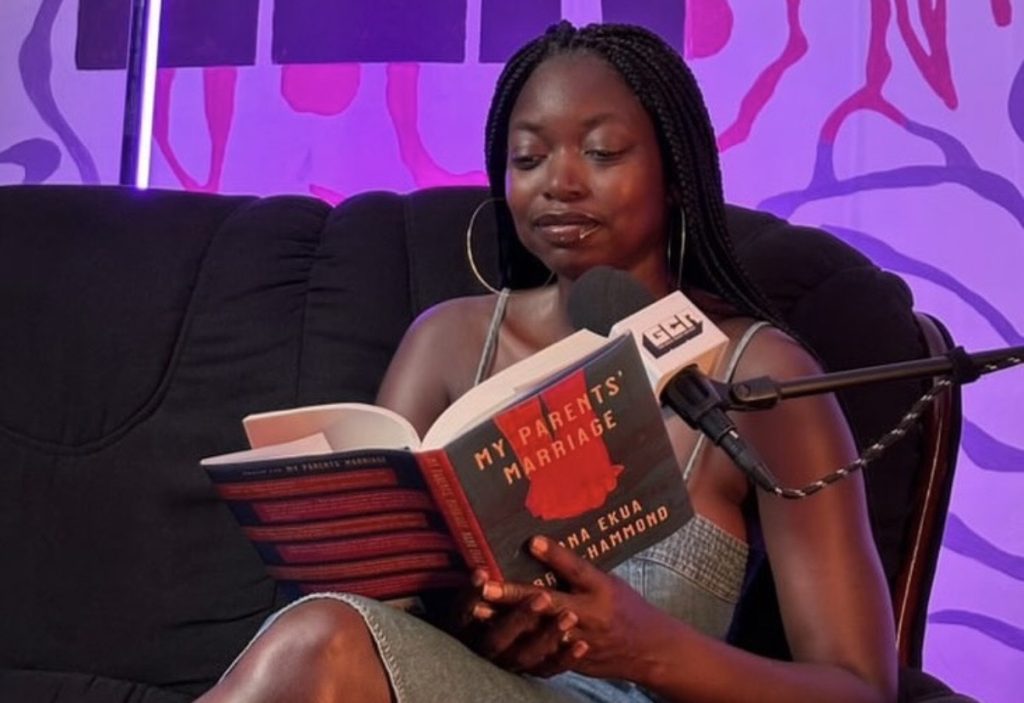
In this conversation, Brew-Hammond will reflect on how her writing lives between cultures, on time and on the tension between imagination and authenticity. She’ll also reflect on an important question at the heart of her work namely, how we live with what we inherit, and whether understanding it is ever enough to set us free.
Chimee Adịọha:
You’ve written across audiences; from Powder Necklace to BLUE: A History of the Color as Deep as the Sea and as Wide as the Sky, but in My Parents’ Marriage, particularly in Kokui’s slow, posthumous reassembly of her father, the novel leans into the ambiguous rather than the instructive. Do you experience these shifts in form as deliberate, or do they emerge from what each story refuses to simplify?
Nana Ekua Brew-Hammond:
Everything I write starts with a question or experience I can’t stop thinking about. When I start to try to find the answers to that question or the words to express the experience, I begin to imagine the reader who needs the work most. That imagined reader dictates the form for me.
Chimee Adịọha:
You’ve lived between Ghana and the United States, and perhaps that contributes to your ability to write Kokui with a kind of cultural fluency that allows her to move; linguistically, socially, and psychologically, across worlds. From speaking the King’s English to slipping into pidgin, from navigating elite spaces to recognizing the subtleties of class and gender around her. When you were crafting those opening pages of My Parents’ Marriage, how conscious were you of writing a character who could be fully legible to both African and Western readers without flattening either perspective, and what did you have to resist, as a writer shaped by both cultures, in order to preserve that complexity?
Nana Ekua Brew-Hammond:
I really wanted to make sure that I did not talk around or down to the reader familiar with Kokui’s experience or context to make it easier for readers who are unfamiliar. Instead, to speak to both, I wanted the opening pages to function like an opening door or window, inviting the reader inside of Kokui’s internal and external worlds.
For the reader who immediately gets the cultural nuances at play, they can immediately insert themselves in the characters’ interpersonal dynamics and invest in the story that way. For the reader who needs to acclimate to a wholly novel setting, I wanted it to feel like going to a new friend’s house or traveling somewhere you haven’t been before. You don’t get a play by play of the meaning behind everything that’s happening, but you gets lots of details about outfits, seating arrangements, the gender gap between the couples, and more to usher you into an understanding of who’s who, what matters to them, and why.
Chimee Adịọha:
You write privilege as both liberating and constraining, as seen especially in the life of Kokui and her frustrated admission that “everything was given, yet something was missing.” How did you approach writing class not just as a backdrop, but as an active force shaping intimacy, gender dynamics, and personal freedom in the text?
Nana Ekua Brew-Hammond:
I just wanted to be truthful about position and hierarchies. Wherever a person sits in a hierarchical structure, there are advantages and there are disadvantages both in the internal experience and vis-à-vis connection with other people. We are all living this life, and life brings different challenges to everyone irrespective of how rich or poor.
Writing Kokui’s character, I thought it important to show that the privilege she has grown up with has insulated her from the day to day struggles of Ghanaians sweating for their daily bread, but to maintain that comfort, she does not see many options outside of remaining under her father’s thumb or finding some other wealthy man to get under. She sees that her mother is independent and flourishing on some level and that her stepmother is financially free, but Kokui does not want financial independence to mean being alone or being yoked to a man who disrespects you.
For Kokui, true privilege means a monogamous marriage built on love, fidelity, and mutual respect, and the freedom to determine her destiny. In getting to this “better privilege”, though, she has to let go of the idea she has grown up with that having money permits you to manipulate others to do your bidding.
Chimee Adịọha:
Kokui’s understanding of her mother shifts over time from judgment to something more complicated and empathetic. There are moments in the novel where she begins to see “not just a mother, but a woman with her own history.” In your view, what makes it possible for a child to begin seeing a parent as a person rather than a fixed role, and why does that recognition so often arrive late?
Nana Ekua Brew-Hammond:
I think growth has to happen before most children understand that our parents are more than caretakers required to selflessly love and raise us. When we realize, whether through experience or age, that every day we all face circumstances that force us to make choices we’re not always proud of, it expands our capacity for empathy. The key word though is “capacity”.
Growth enables us to see that we are all working out our issues in real time, but no one can control how or when we apply the lessons life teaches us. Coming to the humbling realization that everyone needs compassion and grace happens at different times in different ways. And we all handle that awareness differently.
Chimee Adịọha:
By the end, Kokui arrives at a kind of understanding, without clear resolution, of her parents, marriage and ultimately, of herself. Do you see that lack of closure as a form of honesty, or, a refusal?
Nana Ekua Brew-Hammond:
I see it as a form of honesty. Our response to a new level of understanding can change, and often does, as our understanding about other things also evolves.
When the book ends, Kokui is still a young woman with so much more to experience. What’s different about her perspective at the end of this moment in her life versus the beginning is that she now has the maturity to understand that her parents did not set out to harm her with their marital issues and that her life is hers to make of it what she wants. Yes, her parents’ choices have impacted her and are part of who she is, but as an adult she is in charge of her choices now, for better or for worse.
Chimee Adịọha:
The novel unfolds partly in 1970s Ghana, a world shaped by social codes you did not directly inhabit. When writing about a time and social universe that exists outside your direct experience, how do you navigate the tension between imagination and authenticity? In particular, how do your own present day perspectives interact with the voices of writers who actually lived within that historical moment, especially voices such as Buchi Emecheta, Zadie Smith and Chinua Achebe, whom you have mentioned have influenced you in the past?
Nana Ekua Brew-Hammond:
Something I’m continually learning about writing is the importance of putting myself in the hearts and heads of the people I’m writing about. When the research is done and it’s just me, the story in my head, and the screen, I try to ask myself throughout the writing process: If you were living in X place at X time, when X was the law and X was common practice; born to X parents, part of X family, how would you think, feel, and behave when faced with X circumstances?
Approaching the narrative this way helps me access the characters’ core longings and honor their existence with respect to the truth of what they’re dealing with. It also steers me away from trying to address certain topics from present-day perspectives and hindsight so I can stay keyed in to what holds meaning for my characters in the time and place they live in.
Truthfulness is what I connect to as a reader, and why I love Buchi Emecheta’s The Joys of Motherhood and Achebe’s A Man of the People so much. I didn’t have to be born in the settings of these books to feel invested because Emecheta and Achebe didn’t make the stories about the time period or the parts of Nigeria the characters inhabit. Instead, we’re invited into the characters’ lives as they move and grow through their respective worlds.
Chimee Adịọha:
Writers often speak of “finding their voice,” but just as often their work seems to resist any single, stable tone. Do you experience your voice as something consistent beneath the surface, or does it shift depending on what a story demands, and perhaps even who you are at the time of writing?
Nana Ekua Brew-Hammond:
A writer’s voice can be found in their style, the themes they return to, and in their approach. When I consider each of my books, as well as the stories, essays or poems I have out there, I see a throughline of trying to connect seemingly disparate dots, usually across cultures or global contexts, to arrive at a bigger picture of understanding of a universal idea, event or practice. The ways I have done this has changed as I have grown as a writer and based on what I was writing, but when I look from Powder Necklace to Yellow, Relations to My Parents’ Marriage, I see a writer mining multiple cultures and perspectives to make sense of things endemic to the human experience: identity, expression, consumption, and relationships.
Chimee Adịọha:
Writers often carry as much that is unfinished as what is published. Truman Capote’s words, “I’m all for the scissors. I believe more in the scissors than I do in the pencil,” point to this known truth. I wonder, in your own work, what happens to the stories that resist being completed, do they remain with you in some way, shaping what you eventually choose to write?
Nana Ekua Brew-Hammond:
For a while I was keeping a digital “hamper” of poetic lines that I would go back to when I was struggling to articulate something. I still try to write down ideas in the moment they come to me so I can return to them. But overall, at least right now, I think of work that isn’t finished as the means that gets me to the end of other works. For example, I spent about eight years writing and researching a novel set in Ghana from 1961 to the early 2000s. I ultimately had to let go of so much of it to produce My Parents’ Marriage, but all the learning didn’t go away just because it no longer made sense for the book I was delivering to my editor. That experience, and the knowledge I acquired, continues to inform my writing and how I approach my work today.
Chimee Adịọha:
Many writers describe a moment when a story stops feeling like invention and begins to feel, almost, like discovery. Do you recognize that shift in your own process, and if so, how do you know when you’ve crossed into it?
Nana Ekua Brew-Hammond:
I know I’m “in the zone”, when I’m so deep inside the story I become part of it. I’ve had experiences where a character refused to do what I was writing her to do because, she let me know, that just wasn’t who she was. Once, a historical figure I was researching began to “argue” with me about how I was thinking about his choices. In moments like those, I allow myself to be carried away, i.e. consider the resistance as an opportunity to explore and expand the story in ways I hadn’t previously imagined, while maintaining responsibility for stewarding the vision of the narrative and the shape it will ultimately take.
Chimee Adịọha:
Looking at your journey; from being named among Africa’s most promising writers to publishing across genres and gaining increasing recognition as an important voice in Africa and the world, what responsibility, if any, do you feel to the stories you choose to tell about African and diasporic life?
Nana Ekua Brew-Hammond:
I just want to be as truthful as possible with my writing, free from the anxiety of airing dirty laundry or falling into Western stereotypes or any kind of fear. I think getting that right is my whole responsibility as a writer.
Interview Credits: Leo Ugwuanyi, Chimee Adịọha