


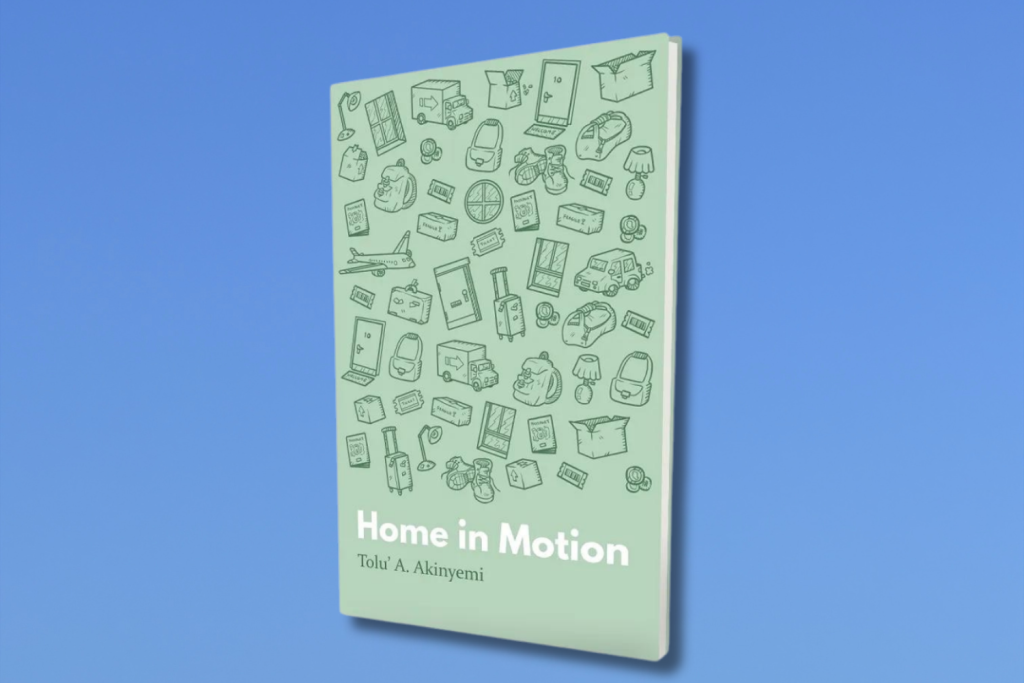
The title of Tolu’ A. Akinyemi’s sixteenth poetry collection, Home in Motion (The Roaring Lion Newcastle, 2025), intrigues me for its poetic reinterpretation of double consciousness. Away from W. E. B. Du Boi’s definition of the term as “a peculiar sensation, this double-consciousness… one ever feels his twoness… two souls, tow thoughts, two unreconciled strivings; two warring ideals in one dark body” (The Souls of Black Folk, 1903), the world Akinyemi paints of his experience as a Nigerian immigrant in Newcastle, England, is far removed from the precarious state of the Black Rights Movement that birthed the concept. Instead, Akinyemi projects the idea of the body as a mobile home, as a home in transition, a home in constant motion, searching for peace and fulfilment. There is a sense in which this resonates as a trope of diasporic sensibility. Here is a poet from Ekiti State, Nigeria, accepting the new reality of being a British citizen in Newcastle but still carries in his heart, the cultural memories of his old home, “English boy, never forget home / Kin & kith of vibrant histories / In the fountain of knowledge / Tell the tales of sharpened axes, trailblazers…” (25).
The lines are suggestive of nostalgia and longing in the form of a stubborn sense of patriotism to his home state. He acknowledges his state’s reputation of academic excellences, praising it for inspiring him to toe the same path. He pays his homage in another poem:
The erudite & scholarly live here:
Men of letters & stupendous acumen.
My recollections of home are fragmented.
I have become a tree
In the forest where men shape words.
I hope this road leads me
To the land of my ancestors,
Through knowledge plains
The greats call home (24).
In ‘Love Affair,’ the poet says, “Write a love letter to Newcastle upon Tyne / Call this place home without apology or / Elucidation / Call it with the affection of a doting lover” (1). Hence, Home in Motion is a eulogy for Newcastle, the city the poet now calls home, “the city of my shining star,” he writes in the dedication, in a tone that exudes peace of mind and fulfilment. Of course, home is wherever you find peace, and Akinyemi suggests, in poems like ‘Turbulence’ (27); ‘Home’ (28); ‘Home is a Replica’ (29); and ‘My Country’ (30), that he fled Nigeria as a result of postcolonial irregularities. He boldly declares that he found fulfilment and purpose in Newcastle but also cries that “There is no figure of speech / That can cage my longing / For home” (31). Akinyemi is in love with Newcastle, he is still in love with Ekiti, hence, it is possible for two homes to coexist in one body. At his “British Citizenship Ceremony,” he pledges allegiance to the king, singing “All Hail the King” (14). This “Geordie stamp,” this “Seal of Approval” (7) buoys him to count himself a worthy citizen of the British empire who would not suffer racists lightly. He challenges a “far right” racist spewing a triggering rhetoric, saying “my blue blood / is contaminated. / Bloody immigrant” (2). “The journey here was not made on a boat cruise or a potpourri of illegalities” (2), he fires back while adding, “I pay my taxes & dues. / Never dreamt of the benefit blues” (2).
Akinyemi writes about the difficulty in fully adjusting to the many shocks of a new home. He bemoans the stiff penalty he had to pay for a minor traffic offence, calling his hitherto celebrated driver’s license a “sour fruit” (11) and being made to spend “a day in court / or a national speed awareness course” (11), something he took for granted in his previous home. A dog breaks free from the leash in the hands of its walker and gives him a hot chase (‘Dog Walker,’ 10); he experiences racism in the nonchalant hands of an emergency operator the day he suffers a fatal panic attack (‘Fate’s Fatal Knock,’ 21); he is a skeptic of the charms of London, same way a Nigerian who had experienced the peace of other states would dread the chaos of Lagos (‘London,’ 18); all these, especially the coded and overt racism leave a “gash” in his heart from the trauma surrounding my new identity” (2). The resilience associated with the authentic Nigerian spirit manifests in his later declaration of himself as “Toon army” (9), boasting that, “This city knows my name / Bore my pain // This is our city––Newcastle City / Where anyone from anywhere […] can crystallise / Into a finished work of art (6).
Tolu’ A. Akinyemi’s Home in Motion benefits from his usage of the free verse, refusing to follow traditional rhyme scheme or a consistent metrical pattern. This allows him to freely express himself but sometimes goads him to excessiveness. However, what a reader might refer to as clumsiness, as in the last line of the second stanza of the poem in page 2, may well be an intentional flaw positioned to demonstrate the awkwardness of racism. His major achievement in the collection is relationality. His demonstration of how people and place make a human. How movement is rewarded with success, with fulfilment. How migration plays a huge role in destiny and positioning. His tone is both reflective and celebratory, both philosophical and assertive. This is a poet who is not shy or calm about his place in the world, the poet who looked Newcastle in the face and roared, “Ekiti poet now calls you home” (9).
Ifésinàchi Nwàdiké is the author of two poetry collections, How We Became Heroes (Noirledge Publishing, 2025) and How Morning Remembers the Night (Winepress 2020), which won the First Runner-up to the Association of Nigerian Authors Poetry Prize, 2020, and was Longlisted for the Pan-African Writers Association Poetry Prize, 2022. His essay “The Ludicrousness of Ungodly Things” (Kalahari 2021) was listed in Afrocritik’s Top 20 Remarkable Essays of 2021 by African writers. In November 2023, his essay was Longlisted for the Sehvage/E.E. Sule Prize for Literary Criticism. In 2025, his poems were Longlisted for the Renard Press Interwoven Poetry Competition, the Joe Ushie Poetry Prize, and the Gently Rippling Waves Prize, respectively. Some of his works have appeared in London Grip, Olongo Africa, IHRAM Press, Maroko, Nokoko, Brittle Paper, Ake Review, Kalahari Review, Lunaris Review, Black Boy Review, JAYLIT, BookArt Ville, LUDD GANG, and elsewhere. An inaugural fellow of the Black Orpheus Exploration Residency, he is a PhD candidate in English and Comparative Literary Studies, University of Warwick where he holds the Chancellor’s International Scholarship Award.